13 March 2009

Private prisons then?

Not PC and I share some discomfort about the private sector being involved in the delivery and operation of prison services - and Anti Dismal has written much about the issue too, interestingly noting the risks of privatising maximum security facilities. This point stands out in an article he quotes "Moreover, hiring less educated guards and undertraining them—which private prisons have a strong incentive to do—can encourage the unwarranted use of force by the guards. As a result, our arguments suggest that maximum security prisons should not be privatized so long as limiting the use of force against prisoners is an important public objective."

Let's be clear - contracting out of ancillary services at prisoners is no issue, and there may be a case for contracting out prison management. The key is the disconnect between incentives to HAVE more prisoners, and the public policy reason for prisons.

Ideally, prisons would be nearly empty because crime would be rare. Ideally, prisons would deliver people reformed and who would never be repeat offenders.

However, a private prison owner would WANT repeat offenders, and would WANT criminals to want to return. That creates incentives not only to not rehabilitate, but to make prison desirable. Hardly what any of us want.

The flipside is that paying prisons to be feared creat incentives for abuse, and for crimes in prisons to be ignored. As much as many of us have glee at rapists and murderers suffering violence in prison, if you want prison to be a place of corporal punishment you should be transparent about it - as in Malaysia. Don't pretend that a Darwinian approach to justice in prison is a civilised substitute.

So I am wary of privatising prisons, wary of profits from applying force to people, wary of the incentives and malincentives around it.

Indeed, as Not PC has already pointed out, why is National and ACT only pursuing THIS privatisation? Why don't the usual masses of the lumpenproletariat give a damn about prisons, when they go apoplectic about privatising TVNZ, NZ Post, Air NZ, Kiwirail or a power company?

Indeed, if any sector needs more of the private sector, it is education. Imagine if ACT's policy, same as the UK Conservative Party's policy, was implemented in some form - parents not paying twice for education.

Now that's a step towards privatisation that would excite me, privatising prisons worries me, especially when mixed with the attitudes shown here by some in government.

10 March 2009

The vile surrender in Pakistan

What disappoints so much is how feminists have failed to rally in protest against the surrender of the Swat Valley in Pakistan to the Taliban. An action that will at the very least deny girls an education, and along with that the means to be independent, to move from the abject servitude to troglodyte men from the Dark Ages, and at worst threatens all people with the totalitarian theocracy of terror that Islamism offers as "morality".

I have written before of my disgust at the appeasement by the semi-failed state of Pakistan in fighting these barbarians, and the actions since the Taliban took over.

Now Jane Perlez and Pir Zubair Shah have written in the New York Times about how the Taliban have now banned music, how people have been fleeing the area and how such appeasement emboldens the Taliban. "The Taliban also announced in the local mosque that every family in the village would have to contribute one young man to their ranks" conscription ISN'T peace.

Christopher Hitchens write in Slate that there is now a new trend of separating the moderate extremists from the extreme extremists "In the last few days, we have heard President Barack Obama musing about a distinction between good and bad Taliban, the British government insisting on a difference between Hezbollah the political party and Hezbollah the militia, and Fareed Zakaria saying that the best way of stopping the militants may be to allow them to run things in their own way".

Imagine talking about those good and bad Nazis, or Khmer Rouge.

Hitchens predicts disaster for the Swat valley "A state or region taken over by jihadists will not last long before declining into extreme poverty and backwardness and savagery. There are no exceptions to this rule. We do not need to demonstrate again what happens to countries where vicious fantasists try to govern illiterates with the help of only one book." Quite, but worst of all it will hurt far wider than the people of that valley.

"who will be blamed for the failure? There will not, let me assure you, be a self-criticism session mounted by the responsible mullahs. Instead, all ills will be blamed on the Crusader-Zionist conspiracy, and young men with deficiency diseases and learning disabilities will be taught how to export their frustrations to happier lands. Thus does the failed state become the rogue state. This is why we have a duty of solidarity with all the secular forces, women's groups, and other constituencies who don't want this to happen to their societies or to ours."

In other words, the war against terrorism is a war against the destruction of civil society by these forces of the Dark Ages giving themselves succuour and a land of people to enslave and bully. THIS is the battle that should unify secularists and those who support individual liberty and the rights of women as a part of that - yet they are mostly silent. Hitchens calls it shameful that this be left to happen "we shall long have cause to regret the shameful decision to deliver the good people of the Swat Valley bound and gagged into the hands of the Taliban, and—worst of all—without even a struggle."

One wonders when the scourge of Islamism will be serious enough for the Western left to unite in disgust, or for the so-called peace movement/feminist left to stand up and recognise that the greatest fight for peace and womens' rights today is against Islamists, who worship violence and the subjugate of women and girls.

Or perhaps it is easier to send faxes about pay equity?

ACC - monopoly without accountability?

What happens if you get poor service from ACC? Well if you are a claimant you can appeal to District Court, but if you pay levies, you have no recourse. In reality, you wont go to Court if you feel treated shoddily, or that your compensation is inadequate. Yes you can sue for exemplary damages, but that's rare.

That is the funny world of the state monopoly accident insurance system. You, as a private citizen, have no responsibility to insure yourself for hurting yourself or others. The state does it for you, after thieving your money. Employers pay through their own levies, which is a tax on your income. It reflects risks in different industries. However, for non-work injuries it is socialism in action - the levies reflect average risk.

I've blogged before about the deception of ACC, whether ACC affects the care taken by others to avoid injury or causing injury, and the benefits of opening it up to competition.

The left bases its support for ACC on a mix of ideology and a debatable report undertaken by accountancy firm PWC commissioned by ACC itself which said why ACC should remain a monopoly. I'll let you judge whether a consultant asked by a client with a vested interest in a particular outcome would dare challenge that or just present the case for that outcome.

I simply say that having a government statutory monopoly providing an insurance service cannot ensure equitable treatment of all those paying or claiming. Without competition, those paying cannot choose to pay for the best service and the most appropriate levels of insurance (and added value services), nor can there can be efficiencies in managing customers or much accountability for delivering the services customers want.

ACC is a pay as you go system, which is an unaffordable absurdity. It needs to face the pressures of competition, in the employer accounts as already reported, but also motor vehicle accounts and for coverage of non-employment based accidents.

The government should commission a serious review of the entire ACC system with a view as to how to restructure it to allow competition for ALL ACC accounts, which means maintaining the compulsory nature of personal accident insurance.

You see, unless the right to sue is returned, personal accident insurance has to remain compulsory, otherwise you can be injured by the negligence of another and have no recourse (or your insurer has no recourse). I believe there is a case to consider whether to permit the right to sue to return, but for now competition in ACC would go a long way towards holding that sector accountable - because for now you get a state owned monopoly, with a board appointed by a politician.

After all, who in their right mind would believe unionist Ross Wilson could run an orgy in a brothel, let alone the national injury insurance monopoly?

09 March 2009

Say no to knighting Ted Kennedy!

The execution by the "Real IRA" of two British soldiers in Northern Ireland comes days after the British government announced that Senator Edward Kennedy is to get a knighthood, for of all things, services to Northern Ireland.

How ironic.

The "Real IRA" sprayed the two soldiers with bullets, including the two men delivering pizzas to them, one of whom was a Pole. They then approached the shoulders and shot them dead on the ground.

Charming.

According to the Daily Telegraph, the sectarian barbarians say Northern Ireland is still "occupied", even though most people in Northern Ireland are glad for peace, and even had the audacity to say that targeting the two pizza delivery men in their bombing was justified because they were "collaborating". What sort of peculiar insanity is it, except the kind of warped Orwellian doublespeak to say that a couple of young men simply making a living were in some way "collaborating" with the Army.

Furthermore, whilst Gordon Brown rightfully described the incident as "evil and cowardly attacks", Sinn Fein (you know, the other IRA's political wing)'s leader Gerry Adams didn't say it was evil.

No. It was "wrong and counterproductive" and "Those responsible have no support, no strategy to achieve a United Ireland." So as the Daily Telegraph's Philip Johnston says it is about tactics, not morality. How could it be, Adams happily believed in executions and violence for decades.

So what about Ted Kennedy? Well quite simply, the Senator for many years was one of the chief agents to raise funds and moral support for the IRA. Simon Heffer describes the honour as a snub to those murdered by the IRA.

We should never forget the support granted by NORAID to the murder and violence in Ulster. Kennedy's positive role in persuading the IRA to give up terrorism is little redemption for the decades he was funding it, and was only due to Al Qaeda's actions on 9/11 which make terrorism suddenly impossible for US citizens to support.

A growing movement is against giving this hypocritical amoral lowlife any honour, see here.

Andrew Roberts in the Daily Mail gives a damning overview of the life of this scoundrel, including his reckless actions in killing Mary Jo Kopechne and being expelled from Harvard for cheating at exams.

Ted Kennedy exemplifies the worst of politics in the United States - a fraud, a thieving conniving pork barrel peddling image merchant who has supported murder and violence. A nasty piece of work if ever there was one. The last Labour government granted Nicolae Ceausescu a knighthood, which was stripped from him a day before his execution. Kennedy is no Ceausescu, but it would be nice if Gordon Brown and this Labour government remembered what an enemy to the UK that Ted Kennedy has been.

Obamaphile kiwis can go suck on...

This.

Yes the Obama administration has ceased discussions on a Free Trade Agreement with New Zealand. Of course the Green Party will be delighted, but the other parties in Parliament (with the possible exception of the Maori Party) should be disappointed.

There was little NZ media coverage when Obama supported a US$40 billion boost in agricultural subsidies back in May 2008, opposed by John McCain.

So he is playing to form, a form that too much of the fawning media ignored, because of the significance of his race. Now you're seeing that he is hardly a friend of the NZ economy, as he does not come from a background interested in free trade.

The negotiations were about a multilateral open trade deal that would include Chile, Singapore, Brunei, and hopefully reports that it is a suspension mean it is a temporary cessation.

My advice to John Key after the election that Tim Groser ought to be heading to Washington as soon as he can after the Obama inauguration can only be re-emphased.

Clint Heine expresses his disgust too.

UPDATE: The Standard ignores the Labour party (as Phil Goff was hopeful it could still proceed) and isn't disappointed at all, showing continued economic illiteracy. Apparently the Standard thinks you should be taxed for wanting to buy something that isn't Noo Zilnd made. How damned ignorant does someone living in an export dependent country have to be to oppose free trade?

Obama's second rate gift to Gordon Brown

Gordon Brown's trip to visit Barack Obama was of no great significance, but what has got the UK media talking is the disparity between the thought and imagination put into Gordon Brown's gifts to Barack Obama and his family, and what Obama gave in return.

Gifts from Gordon Brown to Barack Obama:
- an ornamental desk pen holder made from the oak timbers of Victorian anti-slavery Naval vessel HMS Gannet;
- framed commission for HMS Resolute, a vessel that came to symbolise Anglo-US peace when it was saved from ice packs by Americans;
- first edition set of the seven-volume classic biography of Churchill by Sir Martin Gilbert.

Barack Obama's gift to Gordon Brown:

- A 25 DVD set of classic American films including ET, Psycho and Lawrence of Arabia (barely American at all of course). The Daily Mail has the whole list.

Gifts to Malia and Sasha Obama:

- a TopShop dress for each of the daughters and matching necklace;
- Six books by British childrens' authors as yet unpublished in the USA;

Gifts to Fraser and John Brown:

- Two models of the Presidential helicopter Marine One, apparently identical to ones available on Amazon.com at US$15 each.


As Iain Martin in the Daily Telegraph says "Oh, give me strength. We do have television and DVD stores on this side of the Atlantic. Even Gordon Brown will have seen those films too often already." Anyone could have compiled that gift given half an hour on Amazon.com or in a major music/DVD shop.

One suggestion is that the DVDs may even be for Region 1 NTSC format for the US, not playable on a standard DVD player in the UK, I wouldn't be surprised.

On the gift to the Browns' children, the Times suggests it was a last minute purchase "having an aide pop to the White House gift shop for a piece of merchandising does not imply a great deal of thought" and more telling that the one official photo showing Sarah Brown and Michelle Obama meeting is hardly flattering, and may indicate how frosty the exchange was.

Of course if Bush had done it, we'd (rightfully) never hear the end of it (such as when Bush gave Brown a jacket)

It's a minor gaffe, but one helluva insult to the United Kingdom and Gordon Brown. Maybe it's because the new US Administration has aides who are thoughtless and unimaginative, but for Obama to accept a series of thoughtful generous gifts from the UK taxpayer and to give something as common and meaningless as a DVD pack is in astonishingly bad taste.

06 March 2009

ACT and crime

I've blogged before about how I believe that "three strikes" as a concept is a good idea, but not in the blunt way it has been proposed, rather by granting to REAL crimes, points so that recidivism is reflected in sentencing. For example, two murders should probably see someone in preventive detention, like three rapes. That concept has merit. My chief concern was extending it to victimless crimes.

However, when ACT MP David Garrett, who we have been reminded drunkenly linked homosexuals and pedophiles on TV, dismisses the Bill of Rights Act, you have to really wonder why the hell the man is in a so-called liberal party. Lindsay Mitchell expresses reservations about Garrett's comments, quite rightly. Now I'm willing to have a debate about three strikes being compliant with the Bill of Rights Act, but the latest dirty deal about gang insignia is sickening.

Blair Mulholland calls it "Nazi" and a dirty deal
Lindsay Mitchell says "I understand that being in government comes at a price. But it's just getting too expensive for this supporter."
Tumeke covers it well too.

David Garrett cheering on the bill that would "also ban intimidating tattoos" should scare the bejesus out of Rodney Hide. This guy should go. He is a NZ First MP in drag.

His maiden speech was about a justice revolution, and indeed there was little I could disagree with. However, he has shown himself to have little regard for individual freedom, and an intolerance of people who are "different" to him, but otherwise harmless.

If ACT proceeds to vote for a bill to ban clothing and tattoos it deserves to be utterly eviscerated internally by its members. The efforts Rodney Hide has made since 2005 to move ACT away from the conservative elements in the party and be more liberal will have been smashed up in one move.

It is right to be tough on real crime, and reoffending. It is right to take ideas LIKE three strikes, and as David Farrar wrote, the Broken Windows methodology. I'd also like, if not a repeal, a significant shift in Police efforts away from victimless crimes to genuine crimes, everything from vandalism and car conversion to violence.

It IS after all the core role of the state to discuss and implement policies that best address protecting citizens from criminals. However, in parallel is ensuring individual liberties of the innocent are not curtailed.

Sadly, not only does David Garrett not get it, but ACT seems to have sold out in the process. It is without any glee that I can say thankfully I didn't vote ACT.

Labour's Newspeak

The Standard has linked to a Stuff report about words and phrases circulated around the Health Ministry that Ministers would prefer to be used and not used.

"Among terms now considered "out" were public health, social change, inequalities and advocacy"

All standards for the left. Public health is a collectivist term, social change is social engineering said nicely, inequalities is used as a proxy to claim outcomes are related to being treated differently, and advocacy is what lawyers do, not public servants.

The Standard calls it Newspeak. It may be, but I find it curious that when National does this, public servants leak it to the press and the press takes it. However, when Labour did the very same thing it didn't make news. Either officials were more loyal to Labour, or the media was not interested (or I suspect, the way Labour did it was less formal).

What happened? Well I was told by officials of the Department of Internal Affairs that there was a clear directive from then Local Government Minister Sandra Lee that using words like "accountability, transparency and efficiency" were no longer acceptable in briefings or Cabinet papers because they were "Business Roundtable speak". Obviously, accountability and transparency are hienous plots to bring down the people's government!

The word "efficiency" was dropped in briefings and reports on transport in favour of "value for money", because efficiency sounded like "New Right economics" to some Ministers of the previous government.

Quite clearly Ministers would get very irritated if they thought advice was suggesting policies of the previous government, or that Labour policies were too hard or expensive to implement.

The vetting of all these came through a new level of engagement between departments and Ministers - the Political Advisor. Political advisors are an idea from the Blair administration in the UK, and they are designed to ensure Ministers get official advice politically vetted in advance. Political Advisors would reject briefings or Cabinet papers before they even got to Ministers, to make sure the (truly) politically correct language and the correct advice was being given. Heather Simpson led this, and she became the vetting agent for all Cabinet papers. She was often referred to as the "Associate Prime Minister" and had power that was only rivalled by Cullen at Cabinet. I wrote extensively about H2 (Helen Clark was H1) over two years ago.

H2 would pull Cabinet papers from the agenda and insert new ones. She would edit Cabinet Minutes if they didn't reflect the "correct" view of what was decided.

I'd be very curious to know what our "friends" on the left would think if National adopted exactly the same techniques, and more curious if anyone in the know (e.g. David Farrar) is aware if the current government has Political Advisors for Cabinet Ministers, and is there is a J2.

John Key said before the election that a National led government would listen to the public service and I gave a few idea about what to ask. Is National exercising political control over the advice given to it?

05 March 2009

The Standard talks nonsense on rail and roads

Just when you thought Frogblog was the leading source of reality evasion on transport, I find I have new respect for Frogblog and that the Standard deserves the prefix "sub" that NotPC rightfully gave it last year. Frogblog recently posted on Kiwirail evidence that contradicts the Green view on things, it gave a flimsy rebuttal, but still all credit to actually looking at broader evidence.

The Standard on the other hands is the repositary of complete ignorance on the topic.

The latest post has Steve Pierson saying of Kiwirail (in a post about ACC, more on that later):

"even if it’s true in the sense that it won’t give any profit to government as a going concern, and will require the Government to put in more money, so what?"

So what? Yes Steve, taxpayers should bend over and let the government shaft them up their fundament right? An unprofitable business is no big deal to the Standard. Then again, the history of NZR in its various guises in my lifetime under state ownership was to be unprofitable from 1970 to 1982, when it was bailed out, profitable for 2 years (after contracted subsidised services), then unprofitable from 1985 to 1990, when it was bailed out again, and profitable for three years before being sold.

Then he says:

"If that were the criteria for whether owning an asset is worthwhile, we should get rid of the state highway system for a start - it costs the Government over a billion a year and there’s nearly nil revenue."

Nearly nil revenue? The government is forecast to receive $897 million from Road User Charges and nearly $1.9 billion from fuel tax (adding the $600 million currently diverted as Crown Revenue then recycled back to transport) from using all roads in the current year. 50% of vehicle kilometres travelled are on the state highway network. So around $1.4 billion a year of revenue is nearly nil?

Oh and the planned expenditure on the state highway network in the current year is $1.26 billion, of which 63% is on capital improvements.

The state highway system raises enough revenue to pay for its ongoing maintenance, with sufficient surplus that it can be used to improve the network, and there is over $100 million on top of that revenue used elsewhere (subsidising public transport).

Then we have mysticism dressed as economics:

"It’s the externalities that matter. Having a working rail system, liking a working road system, allows the economy to work much better than it otherwise could. That produces tremendous wealth, even though it doesn’t show up on Kiwirail’s balance sheet."

Externalities? Yet when the Surface Transport Cost and Charges study dug down into the marginal costs of road vs rail freight, the differences between modes varied considerably. In two out of three cases, road user charges revenue paid were in excess of all externalities, in the other case it fell short. So it is NOT cut and dry.

However, this nonsense about it producing "tremendous wealth" is pure mysticism.

Let's see the wealth creation from Labour and the railway system:
- $665 million to buy a company that couldn't pay its bills (track access charges), when its market valuation was around two-thirds of that;
- That same company needs hundreds of millions of dollars to just keep doing business over the medium term, and wont generate a profit from that.

The Standard has been a cheerleader for the rail religion for some time. It described renationalisation as such:

"The Government has acted in a way that makes economic and environmental sense. The only opposition has been from the ‘free market is always right’ lobby and National. Their childish comments about buying a train-set have fooled no-one."

Childish? Using analysis which the government itself commissioned from consultants?

Steve Pierson before that talked absolute drivel suggesting enormous demand for Kiwirail:

"Businesses are keen to take more freight off the road in the face of skyrocketing fuel prices and long-distance car travel is also getting out of reach for many; KiwiRail will provide an alternative."

Which businesses? Who is thinking of dumping their car for long distance passenger rail?

You see, the subStandard thinks it is about ideology not evidence:

"The only reason I can think of is that National/ACT doesn’t like KiwiRail and insulation because they were the Left’s iniatives. There is certainly no pragmatic reason to drop them. From both an environmental and economic stand-point investing in rail and warmer homes are the best options."

None Steve? When nobody has done a study on the economic or environmental benefits of subsidising rail? When a government pays well over the odds to buy an unprofitable business?

Dare I suggest the Standard has superseded Frogblog in abandoning evidence and preaching the religious mantra "rail must be good" - a faith based initiative if ever there was one.

Newspeak at the Standard

Let's say I have a shop, and I have a product on display. You want me to hide it, I choose not to do so. Have I changed the situation? No. YOU wanted the change and didn't convince me. Right?

No - not according to The Standard's Ministry of Truth. Apparently the government's refusal to ban tobacco displays in shops is going to make it EASIER for kids to get tobacco than at present, which funnily enough is that shops can have tobacco displays.

Like has been allowed the entire term of the government The Standard has glowingly loved.

Not only that, but the government WANTS kids to smoke. The reason given by Health Minister Tony Ryall was the lack of evidence that such a ban would be effective, but The Standard prefers a Parliamentary select committee (which face it is just MPs expressing opinions, NOT experts) to a Minister taking advice from officials.

You can see how the folks at The Standard could get a job overseas, such as at the Korean Central News Agency, which is a daily factory of twisted Orwellian fiction.

Of course I'd simply say that it is nobody else's business how a shop displays products that it is selling legally. If you don't want your kids to go to the shop, don't take them or tell them not to. Unless, of course, you have the kids sick of being told what to do by you, or are really dumb and will start smoking because of a product display, despite you warning of the health risks.

Auckland councils have a laugh

$22 billion! The draft Auckland transport plan seeks that amount over 10 years. $2.2 billion per annum, divide it by 1.4 million Aucklanders means $1,571 dollars per man woman and child,

Stuff rightly points out it is "little more than a wishlist", it is hardly a plan. It is like listing what you want if you win the lottery, except Auckland councils want to make you pay for it, whether by rates, fuel tax or general taxation.

Current road taxes are adequate to maintain and make regular improvements to the road network, but any serious major improvements ought to be put through the "toll" test. If it can't be funded through tolls (and road taxes collected from the road), then it probably isn't worth doing.

I've suggested before that a good pilot for private investment of Auckland roads would be to sell the Northern Motorway from Spaghetti Junction to Constellation Drive, allow the owner to toll it which could fund duplicating the congested Victoria Park Viaduct, strengthening the Bridge and a second crossing IF it is viable. Oh and the proceeds from the sale could be allocated to Auckland motorists.

However, in the big picture there is a demand for all sorts of passenger rail network extensions, when none of them could generate enough revenue to cover operating costs. There is ample evidence from the Sydney and Brisbane airport railway lines that an airport railway line does not make sense.

What is most apparent is that this is driven by the public transport obsessed ARC, which has bought into the failed cargo cult ideology that building public transport relieves congestion. You can see it from this statement:

"A rail tunnel under the CDB, for example, would result in more than 200,000 people being within 30 minutes travel of Queen Street"

I'd say far more than that are within 30 minutes travel of Queen Street already. Those people own their own vehicles, and their fuel tax more than pays the cost of the infrastructure they use, and pays to subsidise the public transport they don't use. These magic people are car commuters.

If ever there was a reason for Rodney Hide to throw away any nonsense of a single Auckland council, it is this - a big Auckland council will demand massive cheques from taxpayers for grandiose projects. The question needs to be asked - Is there a role of local government in transport?

Worthless asset - Part 2 - what can be done with Kiwirail?

I like railways and I am an economic rationalist. I find it a little sad when a railway line closes, as if its purpose, hauling goods or people, is no longer needed, like a piece of economic history, and that for a long term it served a useful purpose to many people as an artery. However, I also resist vehemently, the idea that people should be forced to subsidise the freight movements or passenger movements of others. Some like railways and don't apply economics to it, like the Greens. Some apply economics, and want the railway shut down.

Some blogs are suggesting that Kiwirail be shut down, which was what Pacific National, past owner of the Tasmanian rail network threatened, until the Tasmanian state government agreed to take over the network. I can understand this view. However, it is NOT a lost cause. Governments have bailed out the railways twice before in my lifetime, now it should be about accepting the massive right down in value on the government's books before trimming it back to what can be profitable.

I've written many times about this already, so I don't want to add too much:
- Subsidising rail freight is subsidising rail freight's customers, which is coal, timber, dairy and shippers of containerised freight. If anyone should be paying for rail it should be them. A subsidy to rail is "picking winners" in those industries.
- A presentation by NZISCR on the future of rail freight, originally linked to by Frogblog. That presentation dismisses many myths about rail;
- Why the Greens are wrong to worship the religion of rail;
- History of previous rail bailouts and Labour's spending of taxpayers' money on railways;
- Consultant's reports to The Treasury on why rail freight in New Zealand is not on a scale or distances that compare favourably to profitable railways in Australia or the USA. Part One and Part Two.

And after that, where IS rail viable.

In summary, I am optimistic about rail transport in New Zealand, if not for the value of the renationalised "asset". Why?

  1. The Auckland-Wellington-rail ferry-Picton-Christchurch-Dunedin route has sufficient traffic to be profitable in the long term. It can carry containerised traffic by the train load efficiently. Similar traffic profitably runs from the Port of Tauranga to the main trunk.
  2. As long as good quality coal comes out of the West Coast and can be sold, it is profitable to send it by train to Lyttelton. Meanwhile, the TranzAlpine tourist train is also profitable on that same route.
  3. Fonterra's milk traffic from Oringi to Longburn, and Hawera to New Plymouth is profitable.
  4. It may be profitable to keep hauling logs out of the Kaingaroa forest, and rail wood products from Kawerau to the Port of Tauranga, and from Kinleith similarly.
Beyond that it needs to be on a case by case basis, and the likelihood is most other rail freight can only profitably run as long as the rolling stock and track can be maintained in a serviceable condition and the revenue from running trains makes a profit on top of that. When trains need replacing or track/bridges on some lines, it will simply be a case of giving up.

If trains aren't to operate anymore, the line can be mothballed, so if anyone else wants to run services they can - at a cost. After a set number of years, if there has been no serious interest (in some cases railway enthusiasts take over the line and run tourist services, such as to Middlemarch in Central Otago, or at Waitara) then the tracks should be pulled up and the corridor reused. If people want to convert them into cycleways, so be it.

Bill English and Steven Joyce should request a report from Kiwirail describing not lines, but freight business by major customers/commodities and route. It should describe how long term the contracts are, their financial position, and any demands for new capital to keep services going, with recommendations for the short term, medium term and long term future for those services. Business like decisions need to be made. If Kiwirail wants more money to invest in profitable parts of the business, it should borrow against those projections and recover it from users.

Oh and while you're at it, think about the state highways being run as a business too, directly charging road users for the cost of using them. The state highways ARE profitable as a whole, but it would be nice if it were explicit, and they were run as a business supplying customers, instead of a bureaucracy following statutory objectives.

Worthless asset - Part 1 - Why is it worthless?

A "investment" huh? Kiwirail is virtually worthless reports Bill English in the NZ Herald.

So what DID Labour and the Greens say about the renationalisation of the railway business? How did it come to this?

Well it started when it was privately owned and Tranzrail. Michael Beard was brought on board to be CEO because the share price of the railway had been in decline for several years. In essence, the railway had been run in the 1990s by railway enthusiasts who treated it as a network business, and expanded services. Beard found that it was not that much of a network business, but a business based on commodities. In essence about transporting:
- Containers long distances between ports, or between ports and major centres (Main trunk line Auckland-Invercargill, and Hamilton-Tauranga);
- Coal from the West Coast to Lyttelton, with minor coal business from Huntly to Glenbrook and Southland to South Canterbury;
- Logs and timber products in the Bay of Plenty to pulp and paper mills, and the Port of Tauranga;
- Milk from southern Hawke's Bay to Manawatu, and within Taranaki.

There is also a handful of other bulk commodity businesses, like LPG from Kapuni, and fertiliser to Gisborne, but that is basically it. Passenger services in the South Island are also profitable (urban passenger rail is subsidised like many bus services).

Michael Beard told the government that unless it subsidised the business, he would close unprofitable lines, and was seeking rail customers to invest in rolling stock to manage the capital risk. For example, log wagons gets damaged regularly in that traffic and have a long life. He was concerned that customers would seek short term contracts that could mean the wagons are useless to TranzRail if it loses the contract to road freight. On top of that, he also recognised that if TranzRail bought new wagons, its customers knew it had little option but to discount heavily to get business from them - because unlike trucks, which have more flexibility, if a major rail freight customers gives up rail for road, the wagons are useless. A big capital risk in a small country.

So Labour panicked and started on a path of rail policy. One of the first steps was to rescue Auckland ratepayers from Auckland councils' own insanity, and stop them buying the Auckland rail network from TranzRail. The Auckland councils were willing to spend over $120 million buying the network. Dr Cullen decided to override them and spend $81 million instead. The Treasury valuation at the time was that it was really worth no more than $20 million. From then we have the story of pouring money into Auckland's commuter rail network, but the bigger story was also bubbling along.

At the time TranzRail was seeking to bail out of the business, so after some extensive discussion, Toll Holdings was interested in buying the company. So a Heads of Agreement was signed with Toll that it would buy TranzRail (a private transaction), the government would buy the whole rail network for $1 and spend $200 million upgrading the track. Toll would have to pay track access charges to run trains on the line, and if it failed to keep up minimum levels of service, others could provide services. Toll promised to invest $100 million on new rolling stock.

The Greens fully supported this policy

In essence, Dr Cullen relieved Toll of the risk of the infrastructure, subsidised an upgrade of it, in exchange for Toll paying to use the network to cover ongoing maintenance. The only problem was that Toll didn't keep its end of the bargain.

Toll said it couldn't afford the track access charges required by OnTrack - the Crown company that took over the tracks. The Greens said the government should offer discounts (subsidies) on condition Toll carry more freight. So Toll kept paying less than the full amount, and ran trains, until ultimately it became clear it wanted out, and we all know what happened next.

Dr Cullen bought the lot - and bought it well above market price, when it really is worth very little. The claims that it was an "investment" are fatuous.

Kiwirail's locomotive fleet is aging and many will need replacing in the next few years if services are to continue. Much of the track is also facing renewal, as are some bridges. As rail is a long term investment (locomotives and wagons last a long time), it is only worth doing this if there is enough traffic to cover not only operating costs, but renewals and a return on capital. Otherwise, it is destroying wealth.

Indeed, when the railway was still state owned it used to run lines into the ground too. The Tapanui branch in Southland carried logs reasonably efficiently, but only barely covered operating costs. When a flood knocked out part of the track, it wasn't worth replacing it as there wouldn't be enough revenue to cover the cost - so it was closed.

The rail network is worthless if the view is taken that it all needs to be replaced in the next few years. I don't believe it would remain worthless if a business like approach were taken, like Michael Beard had suggested (although he wasn't entirely correct).

NEXT - What to do with rail?

04 March 2009

Tax slavery instead of wage slavery?

Frankly what's the difference? The difference is so called wage slavery is working for money for yourself. Tax slavery is working for money for other people.

Around a week ago Idiot Savant posted on how he thought people couldn't truly be free if they had to work to pay the rent, pay for food etc. They could only truly be "free" if they could decide for themselves how to spend their time, essentially, if they didn’t need to work to have enough money to live.

He believes that employment is “wage slavery” and that the government should provide a guaranteed minimum income that would allow everyone to be housed, clothed, fed and essentially maintain some sort of basic existence (which in many developing countries would be called rich). Only then, does he believe, will people be truly free because they could do what they want with their own time. You could spend your whole life in leisure, start up business, be an artist or whatsoever. Freedom?

Well he neglects to note the obvious point that the “government” does not create money out of thin air (or rather when it does it is called inflation), and has to take the money for such an income from everyone else. The person bludging (which IS what it is) on the guaranteed minimum income may be “free”, but it enslaves everyone who DOES work for an income, or earns income by any means. What happens if half the working age population decides to take a break? Those who don’t must work and pay tax sufficient for themselves, their families and those of the “free”. That is tax slavery. By what moral measure should the existence of others force you to sustain them – and Idiot Savant wants you to do so unconditionally. Because someone having to do something for a living is slavery.

It’s not. It’s reality. If everyone sat back wanting their guaranteed minimum income, everyone would starve. Short of having been gifted (such as through inheritance) or winning a substantial sum, people have to sell their services – as a combination of mind and body – for others to exchange it for money, or goods and services. It is reality. The same reality states that if a house isn't maintained, the roof may leak, or it may catch fire, or the piles may collapse. It is not "slavery" that you need to maintain assets like this to avoid certain risks.

It is reality.

Leisure is a luxury, the wealthier and more productive people have become, the more leisure they have. The answer to more leisure is not to pay people to be unproductive, but to set people free to be as innovative and productive as they wish, within the bounds of individual rights.

That, you see, is what Idiot Savant and Chris Trotter do not understand. They are stuck in the Marxist mindset that employers have their boots at employees' necks. Perhaps when either of them have established businesses, mortgaged homes, worked extensive hours for nothing to make a business work, and then hire people, can they truly judge what it is to be an employer - and stop thinking they all look and act like Montgomery Burns.

You're buying some trains!

Yes according to the Dominion Post, NZ$115 million, partly made up of new locomotives, from the centre of excellence - China. Partly 17 "new" (secondhand ex. British) carriages to replace the ones for the long distance passenger services.

No you wont get a free ride on the trains, because although you own it, the vagaries of "public" ownership of the means of distribution means you have none of the benefits of private property ownership, and all of the costs of it. Now the carriages were already committed by Dr. Cullen, and to be fair if you split out the long distance passenger business, the TranzAlpine express is a profitable service that returns enough to pay for new trains. The TranzCoastal (Picton-Christchurch is more marginal), and the Overlander (Wellington-Auckland) we all know is probably at best breaking even on operating costs (with the drop in tourism hurting it).

This isn't helped by Green MPs virtually never using the services for travelling around the country.

Of course it also means that Kiwirail's competitors are not only subsidising the infrastructure, but now the motive power behind the trains. Think truck tractor units will be subsidised? Of course not.

What I found disturbing was that a new Treasury run infrastructure unit would "develop a 20year plan ranking projects according to their economic benefit". Given the first thing that has been approved are a bunch of locomotives, I wouldn't be trusting the evaluation of economic benefit for one moment.

If this unit approves electrification of Auckland's commuter rail network then it will be transparently clear that the appraisal methodology is nonsensical.

If this unit IS going to do good, perhaps it should also appraise based on "will the government spend this money better than the taxpayer" and "does this spending crowd out the private sector in the same sector". Then the unit will spend little time saying "no" and "yes" at least 90% of the time.

Bill, it's simple. The railway should borrow money itself to invest in capital that will generate a return on investment. OnTrack should develop an open access regime so that others can operate on the railway. The roads should be commercialised, and the power companies should raise capital privately. Give Telecom back its private property rights and amend your RMA reform to focus on private property rights. There is nothing else the government can do to assist in the development of infrastructure beyond getting the hell out of the way. Cutting company tax to 20% would be a good first step

Stuff the Times?

Hmm. Stuff now looks a bit like the Guardian website, or the Times website, or the Independent website. Well the headline fonts anyway.

What's that about? And will the Fairfax newspapers in New Zealand start collectively having content that even approaches the Times? (even the Guardian, commie rag as it is, has more quality content - and at least everyone KNOWS it is a leftwing paper, it doesn't pretend to be otherwise).

When the Church endorses grand theft

As one of my eccentric interests, I like to read about the peculiarities of dictatorships around the world. They are a great lesson in what to watch out for, and how not to run countries, and the stories that come from the excesses are often too ridiculous for fiction.

The two common themes of most dictatorships are theft and murder. Most combine both, it is merely a matter of scale. Some do more murder than theft, Pol Pot and Hitler being good examples of that. However some do more theft than murder.

Dictators take money from citizens through taxation, through appropriation of land, appropriation of businesses, granting privileges and monopolies to their own businesses and raiding aid budgets, as well as sly deals with foreign companies as pay offs to trade with nationalised industries. What they do with that money can defy the imagination.

So what has that got to do with the Vatican? Well the picture above is of the Basilica of Our Lady of Peace of Yamoussoukro, Côte d'Ivoire, with it standing out clearly on Google Earth. It is listed as the largest church in the world by the Guinness Book of Records. It could merely have been a monument to the more thieving and relatively less murdering autocrat Félix Houphouët-Boigny, President of Côte d'Ivoire from 1960 to 1993 when he died, with an estimated personal wealth of over US$7 billion.

The Basilica reflected his mad project in 1983 in shifting the capital from Abidjan to Yamoussoukro. It was a small agricultural town until he had built a series of large buildings and a airport capable of handling Concorde charters. The Basilica cost US$300 million in 1985 values, and took four years to build. Interesting for a country with a per capita GDP (PPP)of US$1,736 per annum, a literacy rate of just over 50%, and the 19th highest infant mortality rate in the world according to the CIA World Factbook. The Basilica is built of imported marble, and sits essentially in the middle of a jungle.

So what, an African dictator wasted money.

Well the Vatican didn't need to consecrate it (French - translated here). To give him his due, Pope John Paul II required that the government promise to build a hospital nearby before he would consecrate it. He laid the founding stone, which lays to this day as all that has been built of the hospital. Not that this would have made it ok - it is grand larceny. This behemoth of a building, is a grotesque palace paid for by thieving the wealth of the country, of people with an average life expectancy of 49 years. For the Vatican to essentially brush that to one side, and claim to be the bastion of morality for the globe is so ludicrously amusing if it weren't ignoring the tragic consequences. Even had the hospital been built, it wouldn't excuse this grand waste.

The Pope's dedication clearly endorses it:

" Par le Chef de l’Etat, cette basilique a été édifiée en hommage à Notre-Dame, en hommage au Christ rédempteur qui appelle tous les hommes à se rassembler dans l’unité de son Corps"

Treating it as if Houphouët-Boigny built it, then says by HIS generosity the social centre is being built next to it:

Et aussi, grâce à la générosité de Monsieur Félix Houphouët-Boigny, un centre social, la Fondation internationale Notre-Dame de la Paix

This is a church that according to Wikipedia:

"the president commissioned a stained glass window of his image to be placed beside a gallery of stained glass of Jesus and the apostles. This image of Félix Houphouët-Boigny depicts him as one of the three Biblical Magi, kneeling as he offers a gift to Jesus"

Imagine what a boost Houphouët-Boigny got by having essentially Vatican endorsement, not only for building the church, but also being a generous guy, with a quasi-religious Biblical significance!

No doubt the Vatican believed the thieving demagogue President when he said it would be a bullwark against Islam and animist religions. After all, that's what's important in the world isn't it? When Time magazine asked the Vatican about the money it said it was the President's money and land and "The size and expense of the building in such a poor country make it a delicate matter. But it is a project close to the President's heart, and he sees it as an experience of faith. We want to respect that."

Now you see what the Roman Catholic Church respects - the thieving of a poor nation by its faithful autocratic Catholic President, and the building of a monument to him with such money. Shame the Pope couldn't have simply consecrated some small modest building instead, as an act of defiance and protest, and asked for the people of
Yamoussoukro to get a reticulated clean water supply and sewage system instead. That would only save lives not souls though.

03 March 2009

Cromwell Crown Hotel London? Don't even think about it

Look it up on Google you'll see the website, you'll see numerous sites with the description of it being innocuous.

No.

This is a shithole, probably the dirtiest hotel in Britain according to the Sunday Times AND Trip Advisor. Surely the highlights of that review are:

"Most impressive is the smell. I’ve never come across anything quite like it — a swirling, gag-inducing mix of sweat and industrial-strength disinfectant, with elusive top notes of spice and decay"

"The mattress was a step into another, stomach-churning world: the eventful history of its long, long life was catalogued in a Jackson Pollock of bodily fluids. Among many other things, it looked as if someone had opened a vein in that bed. I wouldn’t have blamed them. "

"I decided to watch TV until unconsciousness arrived. The ancient set didn’t seem to work, though, so I felt back along the wire to make sure it was plugged in properly. Bad move. As I groped under the chipped MDF dressing table, I touched the plug — and the back cover promptly fell off, leaving the live wires exposed to my wandering fingers. There’s nothing like a 240-volt shock to put things in perspective."

"The phone by my elbow — yes, there is a phone — is encrusted with muck, as if a succession of people have jabbered into it while eating peanuts."

Now I might say anyone expecting much for £55 a night in London is having a laugh, but while you can expect small and basic, you should expect clean and safe. The Cromwell Crown is, quite possibly, the worst hotel in London. You cannot get a good deal to stay here.

02 March 2009

Time to set students free

Clint Heine blogs about the next attempt to free membership of student unions from the absurd half-arsed legislation at the moment, whereby the majority of those who vote to compel all others to join a student union, regardless of whether or not that association represents their values.

It is a very simple issue, one that so clearly out the "we know what's best for you" authoritarian bullying of so many on the left. It is violence of a quite sinister kind to say you can't buy education from a university, without joining an organisation that does nothing that interests you and which represents the opposite of your views. However, I guess given that student unions have so often been the training grounds for Labour and Green party MPs, kind of makes it ok to force everyone to belong right?

Those that proclaim freedom of association suddenly go "oh um student unions are different". They argue "student unions provide lots of services for students", which of course you could say about ALL unions, or indeed most voluntary associations. The student union could simply exclude participation from those who aren't members, it's not that hard, and hardly an excuse to force people to belong to something they don't want to join. They argue "students advocate for students", which surely should be up to students. I could argue Libertarianz advocates for all individuals. Communist parties claim to represent all workers. The Maori Party no doubt claims to look after the interests of Maori.

Student unions could be organisations that provide facilities for students and advocate for them at the university, and make life at university more interesting. Most do some of that, but they also become rallying points for left wing activists. I was sick of student unions claiming to represent my views when they never did - they got 10% of students voting, and were chronic mismanagers of other people's money.

However, none of that actually matters. What matters is that you are not forced to join an association if you don't want to. Student unions should have to convince people to join them, not force them.

If you can't understand why force is wrong, then maybe I should take some money off you once a year, and tell you that you've joined an organisation you didn't want to join, and that it now represents you.

ACT'S Voluntary Student Membership Bill should be supported as government policy.

I did ask a while ago that all National candidates should be asked whether or not they support voluntary membership of university student unions.

ACT's bill will be a perfect way to out those National MPs who are lily livered wimps, that don't believe in freedom of association. Which is why John Key should declare it is party policy - let those who don't support it show themselves. Let's hope I am wrong, and none exist, after all, what better way to undermine one of the best force funded training schools of the Labour Party than to stop making students pay for them if they don't want to.

28 February 2009

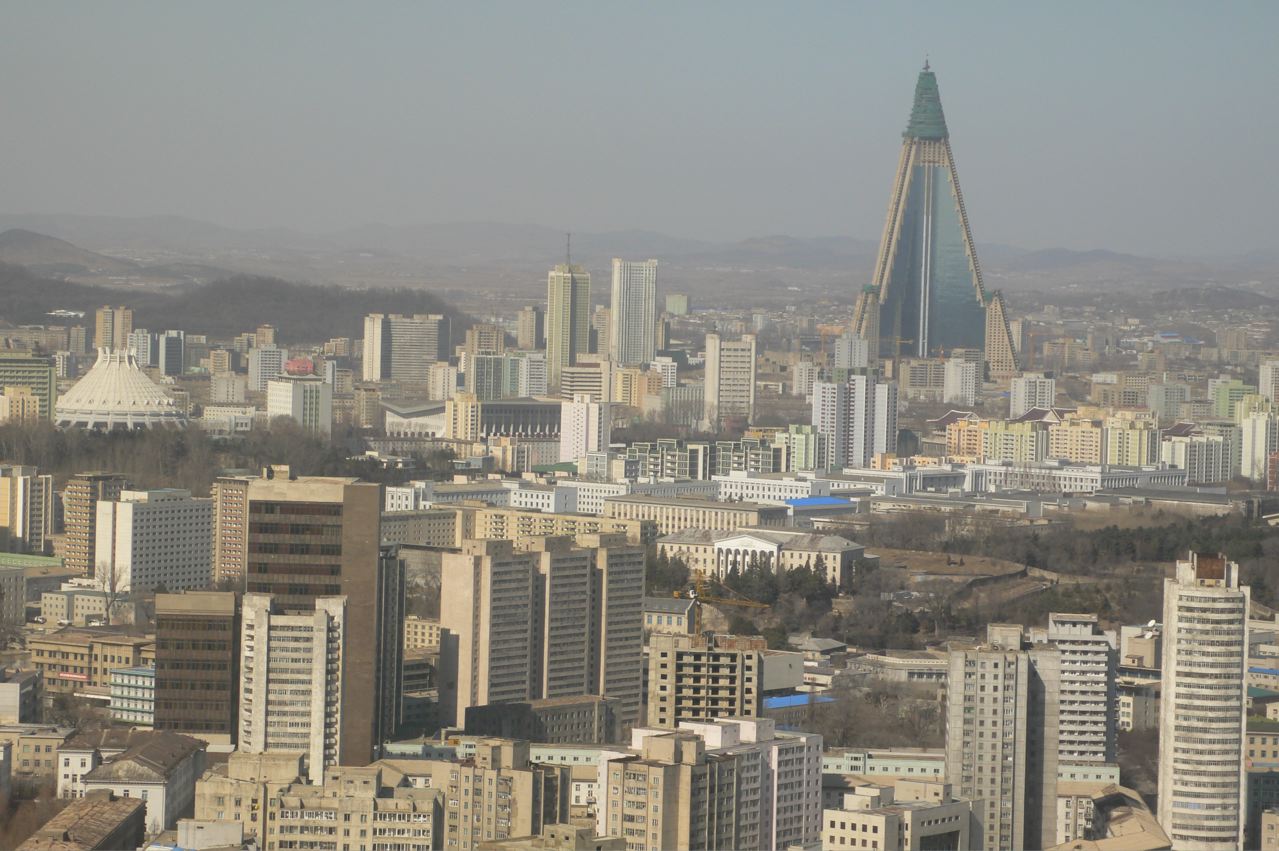
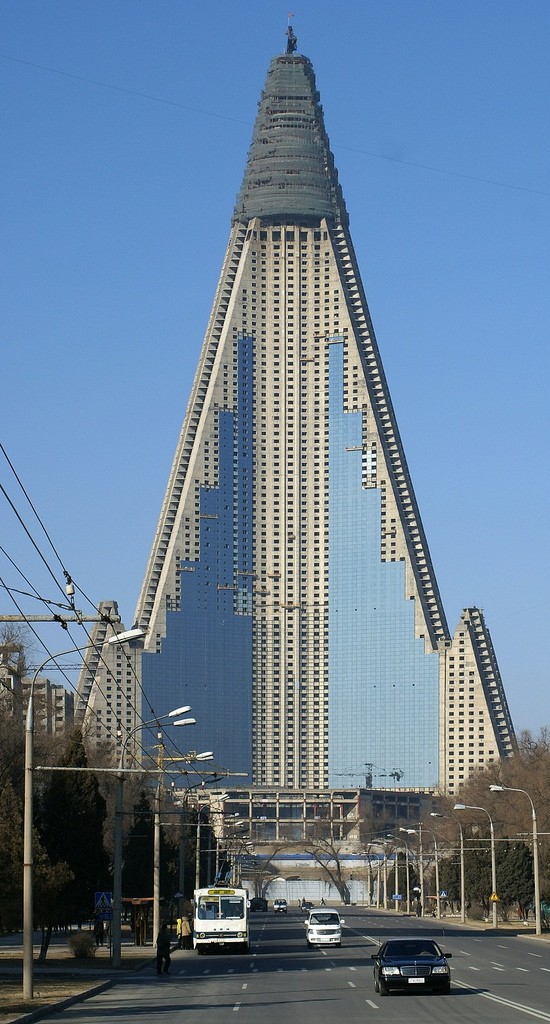
Ryugyong hotel being completed?


Not PC describes it as the worst building in the world. Wikipedia tells about its abortive history. The building that looks like a shard of glass has fallen from the sky or shot itself out of the ground.

However, someone has decided to upgrade it. Egyptian company Orascom is refurbishing it to make it a tower for cellular phone service. Quite how many customers it expects for the phones or the hotels is a mystery especially since most citizens are not permitted a private phone (for obvious reasons), and tourism is rather low. So now we have pictures of it being clad in glass (right).

Scaffolding at the top presumably to allow telecommunications equipment to be installed. Although the rusty crane that has been at the top for around 20 years appears to be there (imagine the worker who was in there - and had to get down).

It has been described as the worst property investment ever by the Times. It apparently will be finished by 2012, which tells me either Orascom knows something nobody else does, or it has far too much money.

27 February 2009

Jobs summit outcomes?

I agree with most of what Not PC has already suggested here, here and here, as an alternative view to the Jobs Summit. These are:
- Government should get out of the way;
- Government should resist pressures for protectionism (one positive thing it COULD do is lobby hard internationally to reboot the Doha Round to make the biggest push for free trade since the 1950s);
- Production drives the economy, not consumption. Precious little government does encourages production. As Government spending takes money out of the hands of the productive, there should be further tax cuts. I'd suggest simply dropping company tax to 20%. What better signal to the world to locate to NZ?
- Abandon the minimum wage;
- Cut government salaries;
- Allow malinvestments to be liquidated;
- Restrict the Reserve Bank's ability to inflate the currency;
and so on.

However, in one respect I DO digress from PC, I do NOT believe all government spending is consumption. It is possible for government to spend money and generate more wealth than it spent. However, this really only happens in two areas:

1. Spending money on capitalising SOEs to expand. A very risky endeavour indeed. Singapore does it well, but you'd question whether NZ governments ever can do it well. Air NZ and Kiwirail being Labour's greatest dud investments.

2. Spending money collected from consumers of a government service to benefit those consumers beyond the cost of the spending. I mean roads. The private sector is almost entirely shut out of providing roads, so government taxes road users and can spend that money on improving roads to reduce delays, wasted fuel, accidents etc. For example, the widening of the highway through Paremata-Plimmerton north of Wellington generated savings in travel time, fuel etc of around $5 for every $1 spent on it. The dangerous side to this is politicians get excited about roads too much, and want to spend money on the ones that DON'T do that. Transmission Gully and the Helen Clark Memorial tunnel (aka Waterview Connection) are examples of this. Japan is littered with such bridges of the sort Henry Hazlitt referred to.

In short, if anyone is advocating spend up on projects, they need a seriously rigorous piece of economic analysis. Will the project really generate wealth based on proven demand, what is the risk contingency on this. If there is a reasonable risk it wont generate at least $2 for each $1 spent over a 20 year period then it isn't worth doing. Sadly the ideas that have come out include the insane idea for a cycleway (although if the government was rational about Kiwirail it mind find it has plenty of corridors for one) and the Green Party's rather predictable favourites.

However, regardless of the economic efficiency of government spending it does not justify it morally. Theft is still theft. I undoubtedly think I can spend your money better than you can, but it hardly justifies me doing so does it?

Finally, it is tragically notable that the leftwing commentary on the Jobs Summit has been virtually nothing about substance or policy (with the exception of the Greens. The Greens played the identity politics card and then ideas), but about identity politics. The Standard showed pictures of men, said everyone has an ideology (true), damns the cycleway (but forgets that Labour started pouring money into cycleways itself) and makes a few comments about what was said. However no new ideas. Idiot Savant goes on about men, and then damns the cycleway (yet this is Green Party policy), and goes on about identity politics again. Hand Mirror thinks it shows John Key does not value women. Apparently women can't be represented by organisations that are open to them and include them.

Not enough women, not enough people of different races. Apparently if you have a vagina or differently coloured skin it means you have different ideas. Those don't come from a brain. If you don't feel represented there, then say so - it isn't because there aren't enough women, Maori, Koreans, blondes, cross-dressers, asthmatics, pianists, vegetarians, balloon fetishists, dancers, nudists or twins - it is about ideas. The truth is that if the summit was full of leftwing women, which would surely cheer many on, the ideas are unlikely to be about getting government out of the way of the productive.

Most of those at the summit were there because it showed they were wanting to work with the government, and because they wanted some booty from the rest of you.

Like I said before, the Fourth Labour Government had an economic summit conference shortly after it was elected, and promptly ignored most of what came out of it. That seems the appropriate precedent.

UPDATE: I see the whingy 23yo unemployed woman who thought the world owed her a living at the Lange Economic Summit Conference, Jane Stevens, retains her Marxist view of the world in the Herald. Given she works for an organisation partly supported by taxpayers and ratepayers, I'm hardly surprised. Shame her passion and commitment didn't teach her that the government produces nothing, and that the free market generates wealth.

Sending freedom messages to North Korea

A Japanese organisation advocating for victims of abduction by North Korea is calling for people to send spam faxes to North Korean fax numbers, in order to facilitate change and revolution.

The blog post above includes the fax numbers, suggests you send a message in Korean only with a photo of Kim Jong Il - because it is illegal to throw away images of the General Secretary. The message should not be confrontational, but be about sending factual information, making the recipient think, and it is important the faxes be individualised.

It IS an innovative approach. Takes a bit of effort to get some Korean written by those who do not know the language, and it isn't cheap. North Korea charges a lot of money to terminate any fax calls in its country (after all that's foreign currency it can earn from overseas telcos).

Imagine if you were in a totalitarian state, knew little better and received a fax from overseas that told you that some of the things your government told you were a lie. Would you tell anyone else? Would you keep it secretly? Would you send a response?

Obama's deficit, spend and tax budget

So President Obama has released his budget. If you believe the hype it would be different, well I guess it is:

- US$1.75 trillion deficit. You just can't begin to imagine how big that is. 12.3% of GDP. He's going to reduce it to US$533 billion by 2013. Wont hear him talking about mortgaging children though;
- He wants to spend US$3.6 trillion, around US$25,000 per taxpayer. However he says he doesn't believe in big government;
- He wants to spend US$634 billion on a health care reserve fund, to introduce socialised health care, though you might wonder whether if every taxpayer spent that around US$2000 a head on health insurance they would be more than covered;
- He wants to increase taxes on the rich (spit on them all of course) those earning over US$250,000 to around 40%;
- He wants to cut military spending, largely as a result of withdrawal from Iraq and Afghanistan;
- He wants to create a cap and trade programme for CO2 emissions that the Federal government will profit from.

Change you can believe in? Or is it just change people are left with when they and their children face this monumental debt to repay? He says he doesn't believe in big government. Who is he kidding?

£15 London-New York return plus taxes

Yep, that's where airfares have gone. Virgin Atlantic announced today it was selling seats in riff raff class at the lowest marginal price in ages. £15 is barely enough to cover the cost of loading an additional meal.

Now to be fair, another £50.30 comprise taxes and levies from the US side, and £55.30 comprises taxes and levies in the UK, plus £106 Fuel surcharge (which goes to Virgin Atlantic).

So it's really £121 fare plus taxes. Still this is a fare to simply recover costs, and let's be clear airlines don't make money on the Atlantic in economy class. A full economy class section loses money for Virgin Atlantic if it carries nearly no one in premium economy class and upper class.

So it's not just the drop in bankers flying the Atlantic.

and don't forget, landing slots at Heathrow are allocated somewhat on a "use it or lose it" provision, so Virgin has to fly the flights to hold onto the slots - which of course are worth a fortune when there isn't a recession!

Jobs Summit?

I largely loathe meetings, unless it is an occasion to tell people what I think and what to do. If I want to know what others think, I'd rather read or hear about it one on one. The bigger the meeting, the less productive it is, because the intelligent people have their time curtailed by the fools.

Having a talkshop about how to create jobs is like having any sort of meeting.

Meetings are where people talk about doing something, not actually doing it.

Imagine a reproduction summit interested in boosting the number of babies. Think how much more productive people would be simply going out and doing it.

So ask yourself this. Are the people at the Jobs Summit (and those complaining they haven't been invited) people who ever create jobs anyway? Of those handful who do (business), wouldn't they be better off being entrepreneurial, or do they see this as a nice taxpayer subsidised excuse to network with others?

I remember the fourth Labour Government, which had Summit Conferences on the economy, Maori and even railways. None of which did ANY good, except make the unproductive feel warm and fuzzy. You see after all that, David Lange, Roger Douglas and co did what was best for the economy, ignoring most of the views expressed at the Economic Summit Conference.

John Key and Bill English could do worse than just sit down with Roger Douglas and listen. They might learn something.

26 February 2009

Dr Cullen and Air NZ

Well it is worthwhile noting both Air NZ's drop in profit and the pending retirement of Dr Cullen. Especially given it is entirely because of Dr. Cullen that you all have a share in Air NZ's future, a piece of history the left conveniently whitewashes over. You see what happened back when Air NZ was in crisis is something that SHOULD have brought Labour down in the 2002 election, but Bill English was too inept, and the mainstream media lacked sufficient journalistic talent and nouse to research it properly. Fortunately, almost all of the relevant papers are now on the Treasury website.

The pro-Labour history around this is simple:
- Air NZ made a bad investment in Ansett Australia;
- Air NZ needed a capital injection to save Ansett and expand its business;
- Two airlines offered this, Singapore Airlines and Qantas;
- As the government was considering both deals, the airline went into crisis;
- This was exacerbated by 9/11 and the global drop in air travel;
- Had Labour let things go, Air NZ would have gone into receivership, damaging tourism and resulting in the end of long haul flights with a NZ brand on them, hurting tourism further. There wouldn't have been flights to many centres in NZ;
- Dr Cullen bravely saved the airline, but required it dump the Australian liability Ansett;
- Then Dr Cullen wisely sought an international partner for the airline in the form of Qantas, because it "makes sense" to have a single South Pacific dominant carrier against the "world".

In other words, the private sector cocked up, and while the government was considering bids for investing in the airline, it was going to fold, and Dr Cullen saved the day. Much of that is nonsense.

That version of history misses out a few facts, facts that demonstrate that the whole situation came about because first the Australian then the New Zealand government stuffed up:

- Air NZ invested in Ansett Australia because the Australian government reneged on a deal for an "open skies agreement" between Australia and NZ. Air NZ originally wanted to set up its own Australian domestic operation in competition with Ansett and the then Australian Airlines. The Australian government reneged on the deal (the famous fax from Laurie Brereton to Maurice Williamson) because it feared it would reduce the price it would get for selling Qantas (which was subsequently to merge with Australian Airlines);

- The Australian government made it clear that it would far prefer Air NZ invest in an established airline - but it was not allowed to invest in Qantas. So Air NZ bought 50% of Ansett in 1996, but was not permitted managerial control at that level of investment and Ansett was required to provide various "social services" (unprofitable routes);

- Increasing frustration with the management of Ansett saw Air NZ finally decide to buy the whole thing out. However it paid too much, it outbid Singapore Airlines as it had aspirations to grow to the size of Qantas. What it found with Ansett was an airline in desperate need of restructuring and new capital;

- Singapore Airlines, which already owned 25% of Air NZ sought to increase its investment to 49% of the airline group, as a capital injection in June 2001. This was unanimously supported by the Air NZ board, but needed support from the Kiwi shareholder - the Crown. Official advice was that issues from such foreign ownership were manageable and that it appeared this was the best option, but the government needed to act promptly.

- Qantas lobbied the New Zealand and Australian governments to oppose Singapore Airlines increasing its investment in Air NZ. Obvious of course that it was seeking to kneecap its biggest competitor. Official advice in June 2001 was against the proposal on competition grounds. The Air NZ board rejected the proposal and Singapore Airlines refused to sell its shareholding, effectively making the proposal academic. Qantas continued to lobby for it;

- In July Cabinet REJECTED the option preferred by Air NZ and officials, preferring either a part state/part Singapore Airlines shareholding or a Qantas takeover;

- Air NZ wrote to Dr Cullen saying that "it would seem that the Government has embarked on a high risk and speculative course that has the danger of putting the Air New Zealand group at risk". The then Acting Chairman warned of the "grave financial risk faced by Air New Zealand Ltd as a result of the current uncertainties;

- Dr Cullen tried to pursue a half and half option allowing some Singapore Airlines investment along with some Crown investment, which was bypassed as the Crown bought out the airline.

Oh and as a side note, the economic geniuses at the Greens believed Air NZ was NOT in a dire financial straight and opposed any new foreign investment, but promoted taxpayer shareholding.

Dr Cullen helped bankrupt Air NZ, because of his peculiar pursuit of the Qantas deal, and the delays in approving the Singapore Airlines investment proposal. You might ask yourself why Dr Cullen didn't like money from Singapore, but liked it from Australia. Not xenophobia surely?

While it is all a bit more complicated than that, the truth is that the slow progress of Dr Cullen and the interference of Qantas has cost the NZ taxpayer dearly, as well as Air NZ. The Greens didn't help either. Air NZ warned that the government's approach created grave risks, and it was right.

So when Dr Cullen steps down, it is worth remembering part of his legacy - the legacy of the lecturer who couldn't make a critical business decision, and surrendered a major strategic opportunity for Air NZ to be a significant airline.

and of course don't forget the Kiwirail deal of the century!

Obama slippery when cliched

So President Obama has done another apparently "inspiring speech". Count the cliches:

- We will rebuild, we will recover;
- What is required now is for this country to pull together, confront boldly the challenges we face, and take responsibility for our future once more;
- Well that day of reckoning has arrived, and the time to take charge of our future is here;
- Now is the time to act boldly and wisely – to not only revive this economy, but to build a new foundation for lasting prosperity;
- But while the cost of action will be great, I can assure you that the cost of inaction will be far greater;
- History reminds us that at every moment of economic upheaval and transformation, this nation has responded with bold action and big ideas;
- For we know that America cannot meet the threats of this century alone, but the world cannot meet them without America.;
- For in our hands lies the ability to shape our world for good or for ill;
- Their resolve must be our inspiration. Their concerns must be our cause.

Blah blah. What REALLY is he doing? Propping up state education, subsidising the alternative energy sector and "reforming" health care. THAT's his plan. He shows NO understanding of why the economic crisis has occurred, making it an excuse to pursue his statist plans for energy, education and health.

He talks drivel about how the economic crisis occurred. "We have known for decades that our survival depends on finding new sources of energy. Yet we import more oil today than ever before". So what? That didn't create the recession, the price of oil is right down again.

"The cost of health care eats up more and more of our savings each year, yet we keep delaying reform" It is also some of the best health care in the world, people don't languish on waiting lists and while it needs reform, he remains empty on what that means. It isn't going to be free for free.

"Our children will compete for jobs in a global economy that too many of our schools do not prepare them for" Indeed, but he opposes competition in the education sector.

"we still managed to spend more money and pile up more debt, both as individuals and through our government, than ever before" yes and you've cut spending and Federal debt, hang on... oh and yes all individuals are to blame aren't they, justifies anything you do.

"we have lived through an era where too often, short-term gains were prized over long-term prosperity; where we failed to look beyond the next payment, the next quarter, or the next election" You mean like when you spend a fortune of future taxpayers' money to bail out businesses and "invest" in subsidies? What's this "we"?

"Regulations were gutted for the sake of a quick profit at the expense of a healthy market" such as? Nice leftwing rhetoric and that's it.

"People bought homes they knew they couldn’t afford from banks and lenders who pushed those bad loans anyway" However you want to bail them all out from their stupidity yet you talk responsibility??

"I asked this Congress to send me a recovery plan by President’s Day that would put people back to work and put money in their pockets. Not because I believe in bigger government – I don’t" However I don't mind it at all, and don't have any other solutions.

"I called for action because the failure to do so would have cost more jobs and caused more hardships" and will do so more in the future. You're guessing.

"More than 90% of these jobs will be in the private sector – jobs rebuilding our roads and bridges; constructing wind turbines and solar panels; laying broadband and expanding mass transit" Generating what economic benefits? Yep you don't know do you?

"I have appointed a proven and aggressive Inspector General to ferret out any and all cases of waste and fraud. And we have created a new website called recovery.gov so that every American can find out how and where their money is being spent." That website is so shallow it isn't funny.

" the budget I submit will invest in the three areas that are absolutely critical to our economic future: energy, health care, and education" Unlike property rights, law and order, roads, services, manufacturing and primary production. Why these three? Nothing.

"Well I do not accept a future where the jobs and industries of tomorrow take root beyond our borders" Code for "I'm an economic nationalist who believes in picking winners with subsidies".

" I ask this Congress to send me legislation that places a market-based cap on carbon pollution and drives the production of more renewable energy in America." China's laughing, Al Gore is wetting himself in onanistic frenzy in his mansion.

" I believe the nation that invented the automobile cannot walk away from it. None of this will come without cost, nor will it be easy. But this is America. We don’t do what’s easy. We do what is necessary to move this country forward." Easy to spend other people's money to prop up a failed sunset industry AND claim to be an environmentalist doing it.

"an American who has never stopped asking what he can do for his country – Senator Edward Kennedy" I believe the phrase "his country" would be more accurate if "his" was replaced with "young" and country had only one syllable.

"In order to save our children from a future of debt, we will also end the tax breaks for the wealthiest 2% of Americans" Note the term "break". As if they get out paying less than everyone else, when they pay much much more. The use of "children" to tug at heart strings.

He promises to cut spending, yet spends more. He talks of warning of protectionism, but has been caught out promoting it, and as a Senator positively voted for it. He talks about recovery, but is seeking to support the unionised federal education system, and fails to understand that government hinders growth and investment.

It's slippery, devious and it isn't change - it is a born again Carteresque socialism that believes in spending your way out of disaster, and talks about debt, without doing anything about it. He talks about avoiding earmarks, but so much of his recovery package was about propping up many Democrat cause celebres.

Obama can make a speech sound good, can plaster it with cliches that inspire the shallow personality cult followers, but behind it all should scare people. Scare them that the President thinks the crisis is about renewable energy, upgrading government schools and healthcare reform. He's so far off the mark it isn't funny, and his collectivist rhetoric should send chills down the spines of those who DON'T believe they borrowed too much, DON'T want to commit to another year of education and DON'T believe they owe anyone anything because of their existence.

UPDATE: Mark V. rightly points out in the comments that Obama's statement implying the USA invented the automobile is false, as it was invented in Germany and credited to Karl Benz. Will the left damn Obama for being ignorant and non-worldly for this mistake, as they would have thrown at Bush, or will they forgive the messiah, like he was forgiven for referring to 57 states? Of course, it will be forgotten and anyone reminding you of it in around 3.5 year's time will be treated as racist.

The filthy war on drugs

Will de Cleene blogs on the case of a 92 year old woman killed by the Atlanta Police during a botched drugs raid. So what happened?

- An officer got a "no knock" warrant to enter this woman's house, in other words smash in to the house, based on evidence that he falsified, following a fake tipoff;
- The officers smashed their way into the house, the elderly woman shot her own gun off as a warning shot, because she thought she was suffering a home invasion;
- They then sprayed her with bullets, and left her to die;
- Marijuana was then planted in her basement, to cover up what they did.

Another victim of the war on drugs, a victim of the maniacal attempts at performance quotas for Police to catch "criminals".

However, I guess it's ok to most people, as long as she isn't your mother, grandmother, wife, sister or friend.

25 February 2009

Hell in Swat - the Taliban's province in Pakistan

I wrote a week ago about the appeasement of the Taliban in Pakistan. Now David Khattakis of the Sunday Times is the first British journalist to enter the Taliban controlled zone, and he calls it a wasteland of blood and fear. Read his article, some of what he describes are:

- one can still see the remnants of the Pakistan Tourism Development Corporation’s flagship hotel. The building was blown up by the Taliban because it was being used for “un-Islamic activities”;
- The women’s clothes markets are either closed or show banners proclaiming: “Women are banned from entering this market.”;
- Barbers have pasted hand-written posters to their shop fronts saying: “Shaving a beard is unIslamic. We have stopped shaving beards. Please don’t visit the shop for a shave";
- all girls over the age of eight are banned from lessons and, in a symbol of the Taliban’s hatred of learning, the public library in Mingora has been wrecked;
- Snooker clubs and video game arcades have also been banned.

It banned English films on the privately owned cable TV network, then music channels, then any content with music, then content in local languages before finally shutting it down.

The appeasement of the Taliban in Pakistan is deeply disturbing, for it is unlikely to stop there. The vision of a Taliban ruled Pakistan may sound far fetched to some, but so was an Islamist Iran 40 years ago. I dearly hope the Pakistan government is simply preparing itself for a solid invasion and to recapture this territory - and it would be nice if there was broad Western support for this. The Taliban is a despicably evil organisation with stone age philosophy, it's about time that all friends of a liberal modern civilisation declared unerring support for its destruction.

David Walliams finds cure for depression


His 18 year old girlfriend reports the Daily Mail.

Her name is Lauren Budd, she's a model, they've been going out for a few months, and well, he's happy. No doubt most men will think good on him, lots of women will hate him, but he's having fun, she's having fun. For a man who is clearly troubled, but is funny and is rather well off, who can be too surprised?

I happened to see him in a corner shop in Belsize Park, London a couple of years ago, although was rather furtive. Unsurprising given the stalker he had at the time!