20 December 2005

Freedom House ratings


Hat tip to DPF for blogging about Freedom House’s annual survey of global political rights and civil liberties, and it is important to remember what that actually means. All the detailed results are here.

Political rights and civil liberties cover the right to vote for all adult citizens (with fair and transparent elections), protest and criticise the government, with political parties having access to the public freely and openly directly and through the media. None of this covers the state’s role in the economy regarding what you can do with your property, income or choices to set up business, or if you can publish a magazine about cannabis, engage in consensual adult homosexual acts or other freedoms – but, nevertheless, without political and civil liberties little else matters.

Most interesting are the ones that are now in the top ranking, along with New Zealand, Australia and most other “Western” countries that one generation ago would have been well down the list:

Cape Verde (yes go look it up)
Chile (Pinochet’s legacy is well and truly gone)
Czech Republic (ex. Soviet disaster)
Estonia (ditto)
Hungary
Latvia (improved on last year)
Lithuania (also improved)
Poland
Portugal (look it up, just like Franco)
Slovakia
Slovenia (ex. Titoist disaster)
Spain (remember Franco?)
Taiwan (free China vs. the mainland)
Uruguay

A mixture of former socialist and military dictatorships now free is not insignificant, and there are more not far behind (Bulgaria, Greece, Grenada, Panama, South Africa, South Korea).

Optimism also with some of the more notable improvements:

Afghanistan (thank you USA)
Colombia
Georgia
Indonesia
Iraq (Andrew Falloon reports that improve freedoms in Iraq are a reason to celebrate)
Kyrgzystan
Romania
Ukraine
Vietnam (higher rating than China for civil liberties due to easing religious expression)

Of some of the pinup countries of the left, Cuba remains in the bottom ranking, while Venezuela under leftist President Hugo Chavez has dropped because of voter intimidation and increased corruption.

And a further note of concern about those that have dropped, in most cases a handful of states from Africa and the Americas, but also sadly Nepal (which is facing full on civil war thanks to Maoist rebels), the Philippines (due to electoral fraud and intimidation of the opposition)) and Uzbekistan, one of the former Soviet republics to be stepping backwards.

Reason to be cheerful? Yes.
Reason to be vigilant? Yes - the war against terror is a legitimate fight against those who would destroy our freedoms and civil liberties, but civil liberties should not also be destroyed as part of that. This is something that politically only the Greens (of those in Parliament) actually seem to understand, and that is what Ahmed Zaoui is all about.

Air NZ engineering part saved by sensible union


There appears to be a deal for part of Air NZ’s engineering services in Auckland and Christchurch to remain, thanks to the EPMU and the Aviation and Marine Engineers' Association negotiating sensibly with the airline to provide service efficiently. Around $38 million worth of savings have been agreed.

However, it will still mean the end of jet engine maintenance as that can clearly be done at lower cost elsewhere. This is not surprising, Air NZ is not a big airline and the economies of scale of bigger operations elsewhere go against it.

This should be seen as a win-win, especially as many of the engine workers who will be made redundant could be snapped up by other employers.
It is also a feather in the cap to Andrew Little and the unions involved - better to negotiate and find a way forward that suits both parties than stand your ground and find you lose it all - Air NZ, after all, has to compete with other airlines. I doubt that many who are supportive of the workers always fly Air NZ to show solidarity.
Nevertheless, Sue Bradford is holding out claiming that engine maintenance is a strategic asset. Well it isn't for Air NZ, and how is it for NZ inc? The engines are not made here, the fuel is not local in origin, and planes are, funnily enough, rather portable. What strategic goal would there be? Would there be a war and our airliners can't hop across the Tasman to get their engines' fixed?
Sue needs to join the 20th century - companies do not need to own all factors of production to operate effectively and efficiently, and they probably shouldn't! Air NZ doesn't make planes or produce jet fuel, or airline seats or anything else - it is an operator, marketer and provider of services. You could argue it "strategically" needs to do everything from fuel to planes - it doesn't - and it shouldn't undertake an activity because it can - because that will cost more, and it will cost the airline - either by increasing fares (reducing market share) or reducing net dividends (and the capital able to reinvest in new planes or other areas of better return).
It's called running a business - which is what it is - and unfortunately, too many Green MPs have little to no understanding of basic economics. Air NZ has needed bailing out twice by the taxpayer in its history, in both cases following excessive interference in its business by the government - as long as the government owns it, it should be left well alone.

EU Budget agreement - Blair's disgrace


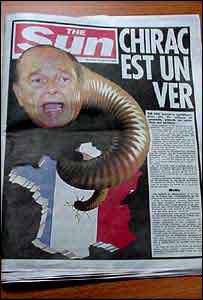
Britain conceded to French demands to cut its rebate negotiated by Margaret Thatcher in the early 1980s, on a pledge by the worm (see below) to revisit agricultural subsidies in 2008-09.

Attempts by Britain to open up the vile Common Agricultural Policy (CAP) and to cut administration spending were stymied by a coalition of the bludgers from the CAP (France, Spain, Italy, Austria, Ireland), the bludgers of administration (Belgium, Luxembourg) and the linking of budget cut proposals by them to the new central european members (Poland, Hungary, Czech republic, Slovakia, Slovenia, Lithuania, Latvia and Estonia).

£198 billion per annum in agricultural subsidies - yes BILLION - is spent by the European Union every year.

France said no change till 2013 - because of an agreement 3 years ago to not change the CAP till after that date. Britain agreed to cut its rebate, the part applying to contributions that are spent in new member states, costing British taxpayers over £1 billion a year, and they get back absolutely nothing. Tony Blair has dropped the ball here - Chirac is thrilled, and it is embarrassing for Britain.

A proposal by Britain to cut spending by £2 billion per annum was laughed off, the new central european members saw that as less aid to them, and the old parasites wouldn't stand for it. The budget will grow to 1.045% of European GDP, less than the 1.24% asked by the bureaurats, but more than what Britain sought (1.03%).

The European Union is good for two reasons, but bad for many more. It is good because it has removed borders to free trade, in goods, services and movement of people between its member states. It is good because it has required liberalisation of domestic markets - so trade WITHIN member states is liberalised. However, it has also seen a growth in harmonised bureaucracy, and subsidies, and a fortress mentality to the rest of the world. For example, Moldova has as one of its fears Romania joining the EU, because it may shut out one of its most important trading partners for vegetable exports - Moldovan farmers have little hope against the cossetted billion euro subsidised farmers of the EU.
The EU needs pairing back, to the bone, to simply be a movement for maintained liberalisation among members -and to enforce a common rule of law among newer members in particular - thankfully the EU does not set tax or welfare policies in member states, yet. However there is little hope the EU will stop growing - even though most of the older EU members have!

WTO agreement tentative - no thanks to France


Jacque Chirac is a worm - and the WTO talks have essentially confirmed that.

A deal is imminent at the WTO talks in Hong Kong, but the South Korean farmers (who can afford to fly en masse to Hong Kong, but afraid to compete with rice produced in Thailand) shouldn't fear - Jacque Chirac has saved their bacon, and helped maintain distorted trade in agriculture, with a tiny concession for 2013. In doing that, farmers in Thailand, Bolivia, New Zealand, South Africa, Pakistan, Indonesia, Australia and many other countries have little reason to be grateful.

The European Union looks likely to concede a 2013 threshold for abolishing agricultural export subsidies (but nothing on import quotas, tariffs or domestic subsidies), even though the US was pleading for 2010 and the Cairn’s Group (including New Zealand) were pushing for earlier removal of export subsidies and progress on other restrictions. Export subsidies for cotton will go in 2006, largely affecting the US and benefiting a number of developing countries.
Least developed countries will get quota and tariff free access to developed country markets for most of their exports, not that this will help agriculture much when the EU maintains export subsidies till 2013, and domestic subsidies continue to grossly distort trade.

Developing countries have also agreed to some liberalisation in the access they give to imported manufactured goods and services, particularly telecommunications, banking and transport.

So what does this mean?

Not a lot, it is glacial progress. It wasn’t without a lot of goodwill from developing countries and the US – and of course New Zealand was at the forefront of advocating free trade.

Frankly, it means the French, by and large, have screwed efficient agricultural producers - rich and poor. Why?
Because it was the EU which refused to make further substantive progress – NOT the US (although it is touchy about domestic cotton subsidies) and not developing countries.
At the EU, there are two blocs on agricultural trade - the reformist group (the UK, Scandinavia, Netherlands) and the ostriches (French, Italians, Spanish and Austrians). The French basically said no, and were not even happy with the 2013 deadline to get rid of export subsidies for agriculture. Lets note that export subsidies consist of 2% of the total value of all agricultural subsidies. France would veto any EU offer that went further.

The USA is often painted as the great world villain exploiting the poor and holding them back, but the US had pushed hard to abolish export subsidies no later than 2010 and to make progress on domestic subsidies. The US agreeing to accept abolishing cotton export subsidies next year is a worthwhile step forward, all export subsidies should go then at least.

The Common Agricultural Policy of the European Union is fundamentally immoral – it props up the wealthiest farms in Europe with subsidies, including those owned by the Queen and Prince Charles – it inflates the price of food to European consumers, and because it is a high proportion of EU spending, costs European citizens in tax. It shuts out efficient producers like New Zealand, Thailand, Pakistan, Bolivia and South Africa from the European market. The EU uses export subsidies of around US$3 billion per annum to prop up exports of sugar, dairy products and beef.

My earlier post outlines some of the absurdities of the CAP.

It is unrealistic to expect the European Union – basically a project that unnaturally marries free trade with socialist central planning – to abolish all agricultural protection overnight. However, it should. It uses four types of protectionism to screw up world trade in agricultural products:

- Export subsidies (undercutting efficient producers worldwide);
- Import quotas and bans (shutting out efficient producers from the European market);
- Import tariffs (taxing imports from efficient producers);.
- Domestic subsidies (propping up the wealthiest domestic producers).

These should go in quick succession – by 2010. With export subsidies, which currently cost US$3 billion per annum abolished first. This would match the offer by the Bush Administration to do the same, and challenge it to follow through on its own import restrictions and agricultural subsidies – for now, Chirac the worm has told the developing countries to go fuck themselves if they want to trade on a less tilted level playing field in OTHER countries, because the French want their “right” to use their taxes to undercut them, till 2013.

However, will you see Bono or Bob Geldof going to Paris to protest against this intransigence? Will you see any of the venom directed at Bush for being, well, Bush – directed at Chirac, the French government and the European Union? I doubt it…

17 December 2005

Swedish nightclubbing


I've not been to Sweden yet, but hat tip to PC who has a powerpoint presentation of some highlights.

Such as...

not a bad way to start the weekend.